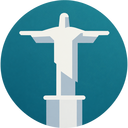
ADR-0123: rio has a window and taskbar icon
- Status: Accepted; the artworks it compares were removed by ADR-0127
- Date: 2026-09-18
- Deciders: jka
- Decision: D117
Context
rio set no _NET_WM_ICON, so nothing told the desktop what the window looked like. The
window manager and the panel each fell back to a default of its own, which is why the
title bar and the taskbar showed two different generic icons for the same window. The
maintainer supplied the artwork: Christ the Redeemer, a pun on the project's name.
ADR-0027 limits rio's iconography to monochrome Unicode glyphs. That rule governs the
iconic controls rio draws inside its own UI, where a font is the right tool and scales
with the text for free. _NET_WM_ICON is a different surface: it takes pixels, and a
glyph would have to be rendered to a pixmap to reach it at all. A window icon is
therefore outside ADR-0027 rather than an exception to it, and ADR-0027 stands unamended.
Decision
rio ships raster window icons and hands the whole set to the window manager. Several sizes are given at once and the desktop picks what it wants — small for the title bar, middling for alt-tab, large for a window list. The set is applied as the default for every toplevel, so dialogs and the help window inherit it without each repeating the call.
The icons are a soft dependency of the same kind as tkdnd (ADR-0086). The files are only ever read, never required: with the icon directory missing, incomplete or unreadable, rio starts exactly as it did before and the desktop uses its own default. Loading an image is never allowed to abort start-up.
No new dependency. Tk 8.6's photo reads PNG natively, which was verified rather
than assumed, so rio's dependency bar (ADR-0115) is untouched.
A Windows .ico sits beside the PNGs. wm iconphoto works on Windows, but the
taskbar and alt-tab render a real .ico better, so one is shipped and used there.
The set is cut from the artwork by a script in the icons directory, and that script is not part of any build. Its output is committed; rio never runs it, at start-up or at install time. It exists so that replacing the artwork is one command, and so that what was learned about cutting this artwork is written down where the next person will cut the next one. It needs ImageMagick, which is a contributor's tool and not a dependency of rio. What it encodes: trim the source's transparent margin before scaling, because at the smallest size that slack costs whole pixels of the subject; and scale with Lanczos and no sharpening.
Every artwork rio has worn is kept, and one committed line names the one in force.
The sources sit together in sources/ under a name each, and active records which of
them the cut PNGs came from. The script lists the candidates, switches to one by name, or
adopts a new file by path. Going back to an earlier icon is therefore the same command
with a different name, and the diff of that one line states which icon a commit changed
rio to — something a set of re-cut binary PNGs cannot say.
An artwork is chosen at 16 pixels, against chrome of both colours. A candidate is cut
and judged at the sizes a title bar and a taskbar actually use — 16, 24 and 32 — over a
dark and a light background, because none of what decides the question is visible in the
512-pixel source. This record states that test and does not name the artwork that passed
it: active is the one line that answers which artwork is in force, and anyone asking can
read it. Naming the winner here as well would mean editing a record every time the
one-command switch is used — the churn the switching mechanism exists to avoid — and the
record would be wrong the first time someone did not.
The size list the loader asks for is a variable, not a literal inside the loop, so the guard that holds it against the files on disk can ask what was requested instead of reading the loader's source text (ADR-0116).
Alternatives considered
Sharpening the downscales. An unsharp mask is standard practice when cutting icons, and the result looked right at 48 pixels. Magnified at 16 it rings: a dark halo along the edge of the pedestal. Rejected on the size that matters most.
Deriving a high-contrast variant for the smallest sizes by post-processing — a dark silhouette where the artwork is weakest. It could not be done for the artwork that needed it: the pale disc and the statue's highlights were too close in tone for a colour key to separate them. Two attempts bled, one reducing the whole icon to a dark blob. Contrast at 16 pixels is a property of the source artwork, and nothing downstream of it can supply what the source lacks.
Keeping one source image and overwriting it. That is how the set was first cut. It makes every change of artwork a destructive edit of a binary file, leaves the commit unable to say which icon it moved rio to, and makes going back a matter of finding the old file again. Keeping the candidates costs a few tens of kilobytes each.
tkimg for image loading. Never needed, and it would have added a fourth hard dependency to carry a decorative asset.
Making the cut a build step. Rejected: it would make ImageMagick a requirement for anyone building or installing rio, to reproduce files that change only when the artwork does.
Consequences
- The title bar, the taskbar and alt-tab show the same icon, and every window rio opens inherits it.
- The artwork is now an asset the project maintains. Changing it means re-cutting the set and committing the result; nothing downstream of the committed PNGs can be tuned per size. Because the candidates are kept, reverting that change costs exactly what making it cost.
- Three artworks have been through the comparison, which separated them decisively even though at 512 pixels all three were good. A pale disc with no outline read on dark chrome and washed out on light. A disc inside a dark outline mended the light case, but its interior detail — clouds — broke into speckle, and its subject stood too close in tone to the disc behind it. What won was the plainest of the three: a near-white subject on a flat disc, no interior detail at all, the subject filling all but a hair of the canvas. The others are kept and are one command away.
- What the comparison settled outlives any of the three. At 16 pixels three things decide an icon, in that order: the contrast at the edge of its largest shape, how much of the canvas the subject fills, and the absence of interior detail, which is noise at that size however good it looks at 256. The case an icon fails is the window chrome it was not drawn against, so a candidate that has only been looked at on one is untested.
- A size that the loader asks for but nobody cut, or a file nobody asks for, would otherwise fail silently — the desktop simply falls back, which looks like nothing being wrong. The set on disk and the set requested are therefore held against each other in both directions.